

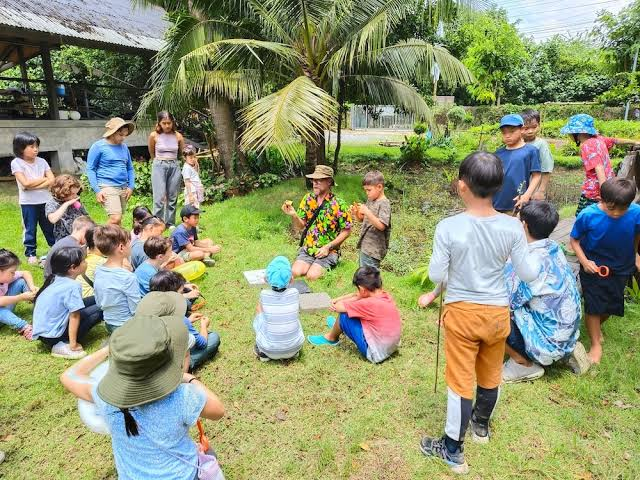
Bangkok has emerged as one of Southeast Asia’s most dynamic cities for internationally minded families. With a growing expatriate community and an increasing number of Thai families seeking globally competitive education, the demand for quality international schooling has never been stronger. Understanding what sets these institutions apart — and how to evaluate them — is essential for any family navigating this complex landscape.
The Rise of International Schools in Bangkok
Over the past two decades, Bangkok has seen a significant expansion in the number of accredited international institutions. Today, families relocating to the city or seeking an alternative to the national curriculum have access to a wide range of programs spanning British, American, IB (International Baccalaureate), and Singapore-based frameworks.
The demand is driven by several converging factors: Thailand’s growing middle class, a surge in multinational company relocations to Bangkok, and a broader global recognition that multilingual, internationally accredited education provides measurable long-term advantages. International schools in bangkok have responded by investing in multilingual faculty, globally benchmarked curricula, and state-of-the-art facilities that rival institutions in London, Singapore, and Sydney.
- Over 170 international schools are currently operating in greater Bangkok
- The majority offer curricula aligned with British, American, or IB frameworks
- Student populations commonly include children from 40–60+ nationalities
- Many schools offer bilingual Thai-English instruction from early childhood
What Families Should Evaluate Before Enrolling
Choosing between institutions goes far beyond comparing tuition fees. Education specialists consistently advise families to assess schools across several dimensions before making a final decision.
Curriculum alignment: A child who has been educated in the UK system may struggle if placed abruptly into an American or Singapore-based curriculum. Families relocating from specific countries should prioritize curriculum continuity where possible.
Accreditation and recognition: Not all international schools hold equivalent accreditation. Bodies such as CIS (Council of International Schools), WASC, and the IBO provide external benchmarking that signals academic credibility and university pathway readiness.
Faculty qualifications: Schools with internationally certified teachers — particularly those holding credentials from the UK, Australia, or North America — tend to deliver more consistent academic outcomes. Staff turnover rate is also a meaningful proxy for institutional stability.
Pastoral support systems: For families new to Bangkok or for students transitioning from a different national system, the presence of counselors, student wellbeing programs, and transition support can significantly affect a child’s adjustment and long-term performance.
Early Childhood and International Kindergarten Bangkok
One of the most consequential decisions families make is where to begin a child’s formal education. Early years programs — typically covering ages 2 to 6 — set the foundation for language acquisition, social development, and academic habits that persist throughout a student’s schooling career.
Bangkok’s international early years sector has matured considerably. Institutions offering international kindergarten bangkok programs now routinely incorporate inquiry-based learning, bilingual instruction, and developmentally appropriate frameworks such as the Early Years Foundation Stage (EYFS) or the PYP (Primary Years Programme).
Families considering early enrollment should look for:
- Low student-to-teacher ratios (ideally 1:8 or better at nursery level)
- Structured play-based learning environments
- Parent communication systems that enable regular progress updates
- A clear pathway from kindergarten into the school’s primary program
- Multilingual exposure, particularly English and a second language
Campus Location and the Urban Schooling Experience
Bangkok’s geography plays a meaningful role in school selection. Traffic congestion in the city is significant, and families often find that proximity to home or office — or access to reliable school transport — becomes a deciding factor as much as academic program quality.
Several schools have established multiple campuses across Bangkok to serve different residential corridors. This model allows schools to maintain curriculum consistency while reducing commute burden for families. When evaluating an international school of bangkok, families should factor in both the specific campus location and whether that campus offers the full range of year groups their child will need through secondary school.
The Role of Singapore-Influenced Curricula
Among the various international frameworks available in Bangkok, Singapore-based curricula have attracted notable attention from both local and expatriate families. Singapore’s education system has consistently ranked among the world’s highest performers in mathematics, science, and literacy assessments such as PISA.
Institutions applying Singapore methodology in Bangkok tend to emphasize structured learning progressions, conceptual depth over surface-level coverage, and rigorous assessment benchmarked against Singapore’s national standards. SISB School is one example of an institution bringing this framework to Bangkok, offering families a curriculum pathway that aligns with internationally recognized Singaporean academic standards.
Navigating Fees, Scholarships, and Value Assessment
International school tuition in Bangkok varies widely — from approximately 300,000 THB to over 1 million THB per year depending on year group and institution. Families should treat published fee schedules as a starting point rather than a complete picture.
Additional costs commonly include:
- Registration and enrollment fees (often non-refundable)
- Capital levies or building funds
- Uniforms, textbooks, and technology fees
- Extracurricular and co-curricular program charges
- School transport
Some institutions offer merit-based or needs-based scholarships, particularly at secondary level. Families with strong academic records are encouraged to inquire directly with admissions offices well in advance of the enrollment deadline.
Conclusion
Bangkok’s international education sector offers families a genuinely competitive range of options — from early years programs rooted in play-based inquiry to secondary pathways leading to globally recognized qualifications. The key to a successful school selection lies in systematic evaluation: matching curriculum philosophy to the child’s learning profile, assessing campus practicality, and looking beyond surface metrics to institutional culture and long-term support systems.
For families specifically looking for a Singapore-framework school with campuses across Bangkok and a strong early years program, more information is available at https://sisb.ac.th/
Contact US
Address: 498/12 Soi Ramkhamhaeng 39 (Tepleela 1), Wangthonglang, Wangthonglang, Bangkok 10310 Thailand
Phone: +660 2158 9090
Email: [email protected]
Website: https://sisb.ac.th/