

Introduction
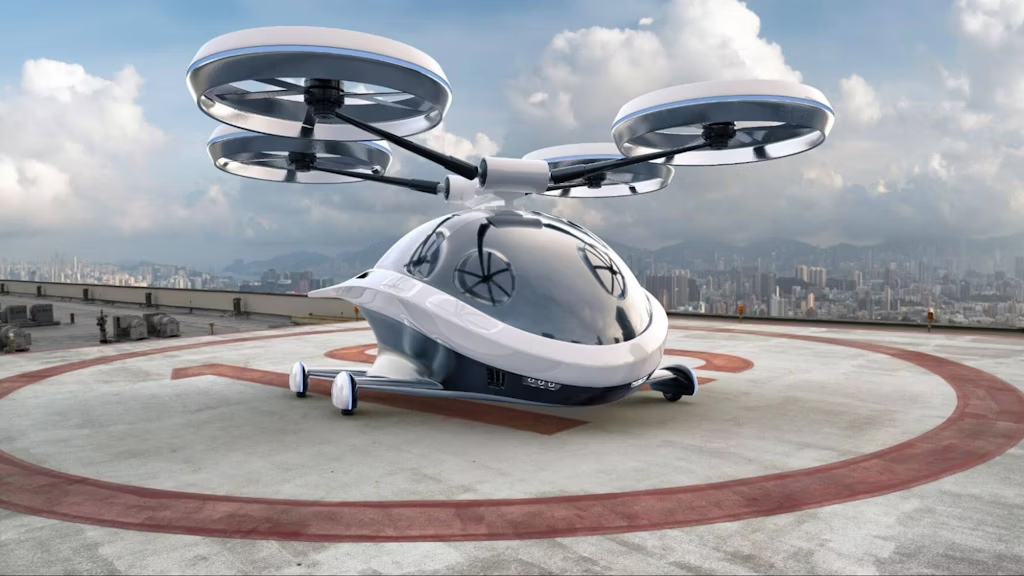
The aviation industry is entering a new era of innovation driven by advances in electric propulsion, autonomous systems, sustainable transportation, and urban mobility solutions. Among the most exciting developments in this transformation is eVTOL technology, short for Electric Vertical Takeoff and Landing aircraft. These next-generation aircraft are designed to take off and land vertically like helicopters while offering the efficiency, flexibility, and scalability needed for future transportation networks.
For decades, urban transportation has faced growing challenges caused by increasing populations, road congestion, environmental concerns, and aging infrastructure. As cities continue to expand, traditional transportation systems are struggling to keep pace with demand. Engineers, governments, and technology companies are therefore looking toward the skies for solutions that can move people and goods more efficiently. eVTOL aircraft have emerged as one of the most promising answers to this challenge.
However, the success of eVTOL technology depends heavily on the propulsion systems that power these aircraft. While most current eVTOL designs rely on multiple electric propellers and rotor systems, innovators are beginning to explore alternative approaches that could further improve safety, efficiency, reliability, and passenger experience. Among these emerging concepts, propeller-free flight systems are attracting growing interest as a potential component of future aviation innovation.
As the aerospace industry continues to evolve, the combination of eVTOL technology and advanced propulsion concepts may redefine how humans travel within cities and across regions during the coming decades.
Understanding eVTOL Technology
Electric Vertical Takeoff and Landing aircraft represent one of the most significant advancements in aviation since the introduction of jet-powered commercial flight. Unlike conventional airplanes, eVTOL aircraft do not require long runways for takeoff or landing. Instead, they can lift off vertically, transition into forward flight, and land in compact spaces located within urban environments.
The concept combines several technological advancements that have matured in recent years. Improvements in battery technology, lightweight materials, electric motors, artificial intelligence, and autonomous flight systems have made it possible to develop aircraft that were once considered impractical.
Most eVTOL aircraft are designed with multiple electric motors distributed across the airframe. These motors power rotors or propellers that provide lift during takeoff and landing while enabling efficient forward flight once airborne. The result is an aircraft that combines some of the advantages of helicopters with the efficiency of fixed-wing airplanes.
Industry experts believe that eVTOL aircraft could eventually support air taxi services, emergency response operations, cargo transportation, infrastructure inspections, and various forms of urban mobility. Many of the world’s leading aerospace companies and technology startups are investing billions of dollars into the development of these systems because they see enormous potential in transforming transportation networks.
Why eVTOL Technology Is Important for Future Mobility
Future mobility refers to the next generation of transportation systems designed to improve efficiency, sustainability, accessibility, and connectivity. As urban populations continue to grow, cities face increasing pressure to accommodate transportation demand without expanding already congested road networks.
Traditional transportation infrastructure often requires years of planning and substantial investment to expand. Roads, railways, and bridges can become overwhelmed as urban populations increase. eVTOL aircraft offer an alternative approach by utilizing airspace that remains largely underused for routine transportation.
By enabling passengers to travel above traffic congestion, eVTOL technology could significantly reduce travel times within metropolitan areas. A journey that currently requires an hour by car might be completed in a fraction of the time using an aerial mobility service. This capability has attracted attention from governments, transportation planners, and private companies seeking innovative solutions to urban transportation challenges.
Furthermore, eVTOL technology aligns closely with broader sustainability goals because most designs rely on electric propulsion systems that produce fewer emissions than conventional transportation methods. As renewable energy adoption continues to grow, the environmental benefits of electric aviation may become even more significant.
The Evolution of Aircraft Propulsion
Throughout aviation history, propulsion technology has played a critical role in determining aircraft performance, efficiency, and capabilities. Early aircraft relied on simple piston engines and propellers, while later generations introduced turbine engines and advanced jet propulsion systems that enabled faster and more efficient travel.
Despite these advancements, many modern aircraft still depend on propulsion principles established decades ago. Rotating propellers, turbines, and rotor systems remain the dominant methods of generating thrust and lift.
While these technologies have proven highly effective, they also introduce challenges related to maintenance, noise generation, mechanical complexity, and safety. As the aviation industry seeks to support new transportation models such as urban air mobility, engineers are increasingly exploring alternatives that can address these limitations.
The search for innovative propulsion technologies has become one of the most active areas of aerospace research. Electric propulsion, hydrogen-powered systems, hybrid technologies, and alternative thrust-generation concepts are all being investigated as potential solutions for future aircraft.
Challenges Facing Current eVTOL Designs
Although eVTOL aircraft represent an exciting advancement, current designs still face several challenges that must be addressed before widespread adoption becomes possible.
One of the primary concerns involves noise. Even though electric motors are generally quieter than conventional engines, the multiple rotors and propellers used by most eVTOL aircraft can still generate significant acoustic disturbances. In densely populated urban environments, noise reduction is essential for public acceptance.
Another challenge involves maintenance. Aircraft equipped with numerous rotating components require ongoing inspections and servicing to ensure safe operation. As transportation networks scale to accommodate large numbers of daily flights, maintenance efficiency becomes increasingly important.
Safety is another critical consideration. While modern aviation standards are extremely rigorous, reducing mechanical complexity can potentially improve reliability and minimize certain operational risks. Future mobility platforms must achieve exceptionally high levels of safety before gaining widespread public trust.
Efficiency also remains a key area of focus. Engineers are continuously seeking ways to maximize energy utilization, extend range, and improve overall aircraft performance.
These challenges have encouraged innovators to explore alternative propulsion concepts capable of supporting the next generation of urban air transportation.
The Emergence of Propeller-Free Flight Systems
Among the most intriguing developments in aviation innovation is the exploration of propeller-free flight systems. Unlike traditional aircraft propulsion methods that depend on rotating blades to generate thrust, propeller-free concepts investigate alternative mechanisms for producing movement and lift.
The goal of these systems is not simply to replace propellers but to rethink how aircraft generate propulsion altogether. By moving beyond conventional architectures, engineers may unlock new possibilities for aircraft design, operational efficiency, and passenger safety.
Propeller-free propulsion remains an emerging field, but it reflects a broader trend within aerospace engineering where innovators are challenging long-standing assumptions about flight. These concepts may eventually contribute to future aircraft that are quieter, simpler, and more adaptable to urban transportation environments.
One inventor associated with this area of innovation is Mohsen Bahmani, whose patented propulsion concept explores alternatives to traditional propeller-based systems. Such developments highlight the growing interest in alternative propulsion technologies as part of the broader future mobility movement.
Potential Benefits of Propeller-Free Systems for eVTOL Aircraft
The integration of propeller-free propulsion technologies into future eVTOL platforms could offer several advantages.
Noise reduction is perhaps the most obvious benefit. Urban air mobility systems must operate within densely populated environments where public acceptance depends heavily on minimizing noise pollution. Alternative propulsion concepts may help create quieter aircraft capable of operating more effectively within cities.
Safety improvements could also play an important role. Reducing dependence on exposed rotating components may help address certain operational concerns associated with traditional propulsion systems. This could be particularly valuable in environments where aircraft operate close to passengers, buildings, and public infrastructure.
Maintenance requirements may also decrease if future propulsion architectures incorporate fewer moving parts. Simplified systems often translate into lower operating costs, improved reliability, and increased aircraft availability.
Perhaps most importantly, propeller-free technologies could provide greater design flexibility. Aircraft engineers may gain opportunities to create entirely new vehicle configurations optimized for urban transportation, passenger comfort, and energy efficiency.
The Role of Artificial Intelligence and Automation
The future of eVTOL technology extends beyond propulsion systems alone. Artificial intelligence and automation are expected to play a central role in enabling safe and efficient aerial transportation networks.
AI-powered systems can assist with navigation, traffic management, route optimization, predictive maintenance, and flight safety monitoring. As eVTOL networks expand, intelligent systems will be essential for coordinating thousands of daily flights across complex urban environments.
When combined with advanced propulsion technologies, AI may help create highly integrated transportation ecosystems capable of adapting to changing operational conditions in real time.
The convergence of automation and innovative propulsion solutions is likely to accelerate the adoption of future mobility platforms worldwide.
Regulatory and Technical Challenges
Despite significant progress, several challenges must still be overcome before eVTOL aircraft and alternative propulsion systems become mainstream transportation solutions.
Regulatory authorities require extensive testing and certification procedures to ensure safety and reliability. New propulsion concepts must demonstrate consistent performance under a wide range of operating conditions before receiving approval for commercial use.
Infrastructure development also remains a major consideration. Future urban air mobility networks will require specialized landing facilities, charging systems, maintenance centers, and air traffic management solutions.
Public acceptance represents another important factor. Passengers must feel confident in the safety and reliability of emerging transportation technologies before widespread adoption can occur.
Addressing these challenges will require collaboration among governments, manufacturers, technology companies, investors, and regulatory agencies.
The Future of Urban Air Transportation
The long-term outlook for eVTOL technology remains highly promising. Industry analysts predict substantial growth in urban air mobility over the coming decades as technology matures and infrastructure expands.
Future transportation networks may include a combination of autonomous aircraft, electric air taxis, advanced logistics systems, and innovative propulsion technologies working together to improve mobility within cities and regions.
As research continues, propeller-free flight systems may become an increasingly important area of exploration. Their potential to improve safety, reduce noise, and support new aircraft designs aligns closely with the goals of future mobility initiatives worldwide.
While it is difficult to predict exactly how aviation will evolve, it is clear that propulsion innovation will remain one of the most influential factors shaping the future of flight.
Conclusion
eVTOL technology represents one of the most exciting developments in modern aviation, offering new possibilities for urban transportation, sustainability, and future mobility. As cities seek innovative solutions to congestion and environmental challenges, electric vertical takeoff and landing aircraft are emerging as a practical pathway toward faster and more efficient transportation systems.
At the same time, the search for improved propulsion technologies continues to drive aerospace innovation. Propeller-free flight systems represent a bold and forward-thinking approach to addressing some of the limitations associated with traditional aircraft propulsion. Although these technologies remain in development, their potential benefits make them an important area of interest for researchers, engineers, and transportation planners.
Together, eVTOL technology and alternative propulsion systems may help define the next chapter of aviation history, creating transportation networks that are safer, quieter, cleaner, and better suited to the demands of the twenty-first century.