
You’ve probably spent hours choosing the right paint color, searching for furniture that fits the size of your room, and finding art pieces that reflect your personality. However, even after doing all that, your gaze still gravitates to the cold white metal vent located somewhere in your room. While air conditioning and heating are essential components of having a comfortable indoor climate, air conditioning and heating vents are not elements of design and aesthetic that are normally considered desirable in the home.
The good news is that you don’t have to choose between comfort and looks. With a little creativity and planning, these functional requirements become less obtrusive and can be incorporated to add to the aesthetic of your home.
Understanding HVAC Vent Basics
Before embarking on how to cover and modify the vents in your house, you should learn about the vent function to avoid malfunctioning your heating and cooling system. Your house consists of two types of vents. Supply vents blow the conditioned air inside the room. Return grilles draw air from the room for reheating or recooling.
Blocking the airflow at either point may put strain on your system, and this may result in an increase in your energy costs and may even lead to the system breaking down. The aim of any modification that you make is to conceal the equipment without blocking the airflow. Check your system before installing a blocking point.
Planning and Preparation
For a successful merge of technologies and design, it is necessary to understand your design style and how difficult your space is to work with. For example, a loft with a modern and industrial feel may incorporate exposed ductwork and metallic accents to showcase the mechanical aspects of your home. However, a traditional or farmhouse theme will call for a more discreet melding of technology that conceals these aspects in the background.
Go through your house to determine where all the vents are. Are they ceiling-mounted, wall-mounted, or mounted in the baseboard molding? Each type of vent, from a wall to a floor register cover, poses different difficulties when it comes to foot traffic or placing furniture around them. After determining where your problem areas are, you can then determine which solution to use.
Creative Concealment Ideas
Painting the vent is also the easiest and cheapest way to make it blend in with the ambient decor. Standard white covers can look quite obtrusive against darker or more colorful walls. But applying a coat of metal primer and then repainting in the same color as your walls or ceiling will make the vent almost disappear from view. Another option for rooms with wallpaper is to cut a section of wallpaper and cover up your vent. Just make sure not to obstruct airflow.
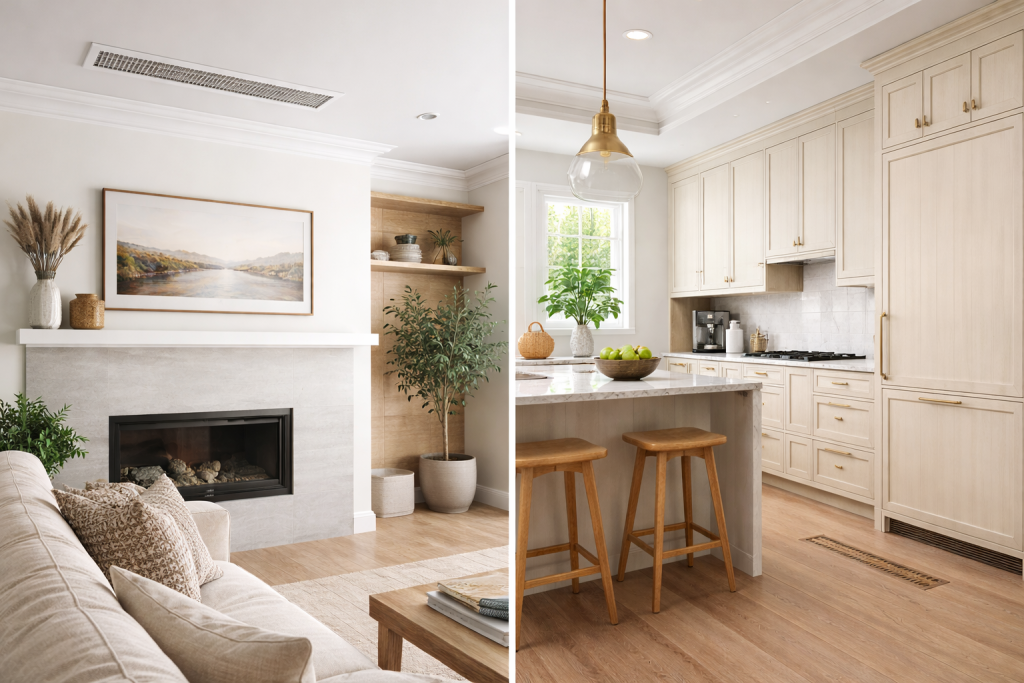
If the concept of painting is a bit pedestrian, think about tackling the hardware itself. The market is enormous when it comes to decorative vent covers that can be crafted from cast iron, brass, and even laser-cut wood. These types of covers will turn a hotspot into a feature. A geometric-patterned vent cover crafted from brass will be a beautiful feature of a mid-century modern setting, and a wooden insert that complements your hardwood flooring is a seamless transition that simply was not possible with the average vent.
For the most foolproof method for seamless design, the integration of these ventilation systems with custom millwork is the most ideal approach. Sometimes, the ventilation can be incorporated in the baseboards or toe kicks for the cabinets. For example, in an island or in an enclosed bookcase, the ventilation can go through the plinth such that there is no visibility in terms of the machinery used but instead blows air inside the room.
Strategic Placement
In other cases, concealment may be less about hiding the object and more about deflecting attention to another area. The positioning of furniture is also an important factor in determining how noticeable your vents are in the room. A console table with legs can be placed atop a wall vent to deflect attention away from it by disguising the line of vision. Similarly, you can place a rattan sofa with legs atop a return vent to conceal it from view but still allow airflow.
It’s a good idea to avoid placing solid furniture over floor vents or wall returns. Not only does this increase the workload of your HVAC system, as a result of increased airflow restriction, but it can also create hot and cold spots within the room. To avoid this, you can use plants, bookshelves, or any other furniture that doesn’t seal off the vents.
Achieving Harmony
In an effective home, the details mean the difference between just a house and a home that is both functional and beautiful. While heating and cooling vents are essential components in any domicile, there is no reason for your house to reflect this. The best way to go about restoring your space is with smart design.
A seamless home design offers an aesthetic where all components blend together. In an effective design, all components will blend together in an efficient manner. This means that all of your features will be incorporated together. This will include all facets of your home design!