

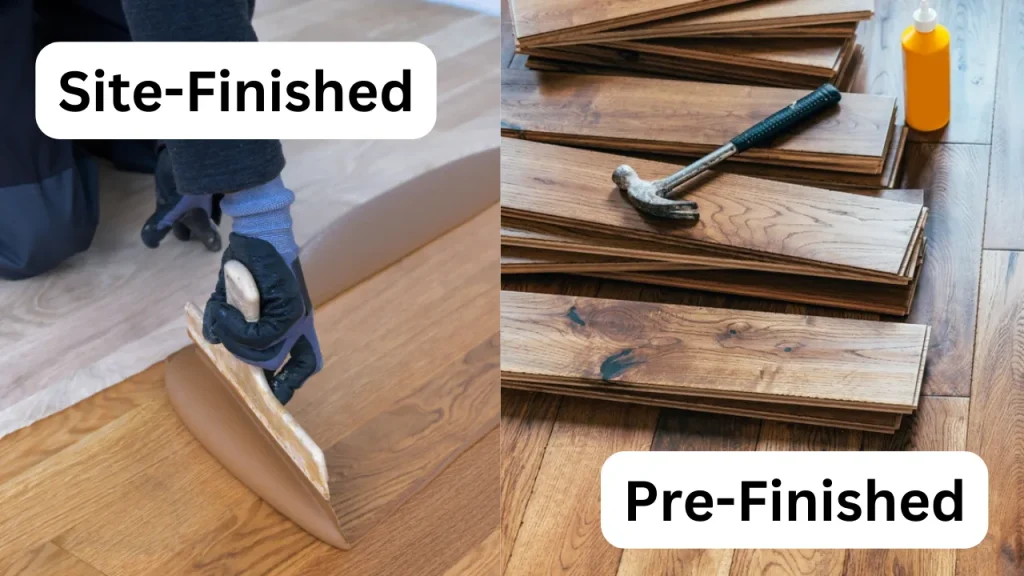
Among the specification decisions on a stair installation project, few have as much downstream impact on cost, schedule, and finish quality as the choice between prefinished and site-finished hardwood treads. The two approaches produce visually similar results when executed well, but the project workflow, the moisture and dust exposure during construction, the warranty profile, and the labor cost structure are meaningfully different. For flooring dealers specifying for clients, remodeling contractors managing project timelines, homebuilders coordinating across trades, and architects writing finish schedules, understanding the trade-offs between the two approaches to stair treads is the foundation of a specification decision that holds up across the project lifecycle and the years of use that follow.
What Each Approach Involves
Site-finished stair treads are installed unfinished, sanded in place along with the surrounding stair components, and finished on site through stain application, sealer, and topcoat. The traditional approach allows the finish to flow continuously across treads, risers, skirt boards, and adjoining flooring, producing a visually unified result that has been the standard for hardwood staircases for generations. The work is performed by a finishing contractor or finish carpenter, typically over multiple days as each stage cures.
Prefinished stair treads arrive at the project complete: sanded, stained, sealed, and topcoated in a controlled factory environment. Installation involves cutting the treads to length, applying construction adhesive, and securing them to the stair structure, with finished surfaces ready for use as soon as adhesive cure permits. The work is typically performed by a stair installer or finish carpenter without involvement of a separate finishing contractor.
Schedule and Project Coordination
The schedule difference between the two approaches is often the deciding factor on production builder and remodeling projects. Site-finished treads require multiple days for sanding, finishing, and cure, with the staircase out of service throughout the process. Adjacent finishing work (painting, trim installation) must coordinate around the dust generation of sanding and the sequencing of finish coats.
Prefinished treads compress this timeline substantially. The installation is typically a one-day operation per staircase, the staircase returns to service within hours of installation rather than days, and the finishing work elsewhere in the project proceeds without coordination around stair finishing. For builders managing tight production schedules and remodelers minimizing client disruption, the schedule benefit alone often justifies the prefinished approach.
Finish Quality and Consistency
Factory finishing produces measurable advantages in coating quality. Multi-coat aluminum oxide and ceramic-reinforced urethane finishes applied in controlled factory environments deliver hardness, abrasion resistance, and longevity that site-applied finishes cannot match. Independent testing typically rates factory-applied finishes at multiple times the abrasion resistance of comparable site-applied systems.
The trade-off is that factory finishes do not flow across the surrounding stair components in the same continuous way that site finishing does. The visual transition between a prefinished tread and a separately finished riser, skirt board, or floor requires coordination of stain color, sheen level, and finish profile to read as unified rather than mismatched. Reputable prefinished tread suppliers offer finish matching against major flooring manufacturers’ species and stain colors, which simplifies this coordination considerably.
Site-finished installations, by contrast, produce naturally unified finish flow but at the cost of finish hardness and longevity. The choice often depends on whether the project priority is finish-quality longevity (favoring prefinished) or finish continuity across the full stair assembly (favoring site-finished).
Construction Environment and Dust Control
Site-finished installations generate substantial dust during sanding and require careful management of finish fumes during application and cure. Occupied remodels, projects with allergies or respiratory sensitivities, and builds with sequencing constraints around finish stage all face genuine challenges with site finishing.
Prefinished installations eliminate the sanding stage entirely and minimize finish exposure on site. For occupied remodels, this is often the deciding factor.
Cost Considerations
The cost comparison depends on labor rates, project scale, and the local market for finishing trades. In general, the materials cost for prefinished treads is higher than for unfinished lumber, while the labor cost is substantially lower because the finishing work has been performed at the factory. The total installed cost is often comparable between the two approaches, with prefinished installations sometimes producing modest cost savings on production builds and modest premiums on bespoke architectural work.
Warranty and Performance Over Time
Factory-applied finishes typically carry warranties of 15 to 25 years against finish wear-through, providing predictable performance over the working life of the staircase. Site-applied finishes vary in warranty profile and depend heavily on application conditions, contractor skill, and post-installation care.
For trade professionals specifying, sourcing, and installing hardwood stair treads on builds and remodels where finish quality, schedule predictability, and long-term performance matter, the team at Wood Stair Co supplies prefinished hardwood stair treads matched to major flooring manufacturers and provides the kind of trade support that allows dealers, contractors, builders, and designers to specify with confidence.
