

Every September, the same thing happens. The light shifts, the mornings get a bite to them, and suddenly the house that felt perfectly fine in July feels a little bare. The instinct is to fix that with a shopping trip: a cart full of throw pillows, a wreath, a candle in every shape, a garland that will be shedding fake leaves into the couch cushions until March. Then October arrives and the place looks like a seasonal aisle rather than a home. There is a gentler way to get the fall aesthetic into your space, and it starts with a simple rule: one swap per room, and nothing more until you have lived with it for a week.
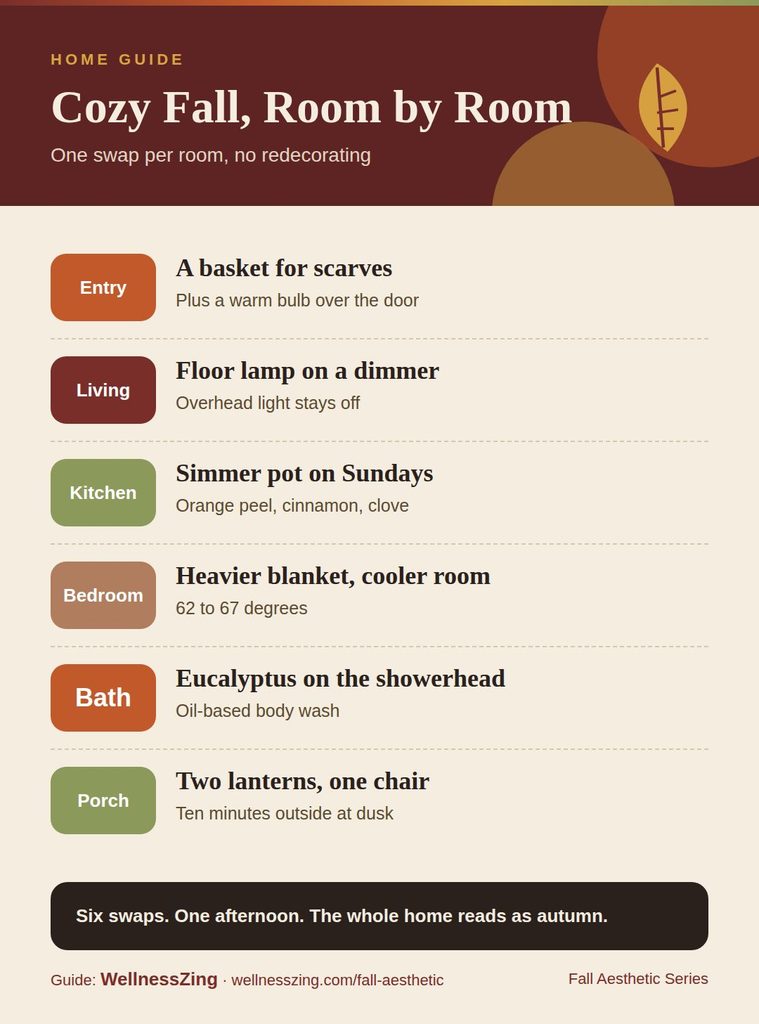
The idea behind the one-swap rule is that most rooms already have a fall version of themselves waiting inside them. The living room wants softer light. The kitchen wants a smell. The bedroom wants weight and cool air. The bathroom wants steam that does something. The porch wants a reason to sit down. You are not redecorating; you are adjusting one dial in each space so the whole house drifts toward autumn together. The infographic below lays out all six swaps, from the front door to the back porch, and the rest of this article walks through what each one looks like in practice.
The infographic at a glance
As the infographic above shows, the plan follows the path you would walk through a typical home, starting at the door and ending outside. The entry gets a basket for scarves and a single warm bulb in whatever fixture greets you first. The living room gets a floor lamp on a dimmer, which does more for the mood of the room than any pillow ever will. The kitchen gets a Sunday simmer pot made of orange peel, cinnamon, and clove, a scent that fills the house for an afternoon and costs almost nothing. The bedroom gets a heavier blanket and a cooler room, with the chart suggesting a range of 62 to 67 degrees Fahrenheit. The bath gets a bundle of eucalyptus tied to the showerhead and a switch to an oil-based body wash, because dry autumn air is hard on skin. And the porch gets two lanterns, one chair, and a standing appointment: ten minutes at dusk, most days, before the season slips past.
Six rooms, six swaps, and not one of them requires a pumpkin. What makes the infographic useful is not the individual ideas, which are all fairly humble on their own, but the way they add up. Warm light at the door, warm light in the living room, a warm smell in the kitchen, a cool and heavy bed, a steamy scented shower, and a quiet spot outside. Walk through a house like that on an October evening and it feels like fall without a single decorative gourd in sight.
The entry: a basket and a bulb
The entryway is the room most people ignore, which is exactly why it matters. It is the first thing you see when you come home and the last thing you see when you leave, and in fall it turns into a chaotic pile of layers within about a week. Scarves on the doorknob, a light jacket on the banister, gloves that somehow separate from each other the moment they enter the house. A single open basket by the door solves most of this. Scarves, hats, and gloves go in the basket. Nothing goes on the doorknob. The basket does not need to be anything special; a woven one you already own or something secondhand works fine, and it looks better slightly overflowing than perfectly styled.
The second half of the entry swap is the bulb. Most entry fixtures come with whatever bulb the last person put in, and it is usually a cool, bluish white that makes a hallway feel like a waiting room. Swap it for a warm-white bulb, the kind labeled soft or warm, and the difference is immediate. The wall color looks richer, the wood on the floor looks warmer, and walking in at 6 p.m. in the dark feels like arriving somewhere rather than clocking in. This is the cheapest swap on the whole list and probably the one with the biggest return, because it colors your first impression of the house every single day.
The living room: a floor lamp on a dimmer
If you only make one change in the living room this fall, make it about light and not about textiles. Overhead lights are built for tasks: finding a remote, vacuuming, reading the fine print on a package. They are not built for the kind of evening where you want to sink into a couch with a book while the rain does its thing outside. A floor lamp on a dimmer gives you a light source at roughly eye level or below, which is where firelight and candlelight have always lived, and lets you turn it down as the evening goes on.
You do not need a new lamp. If you have a floor lamp already, a plug-in dimmer switch that sits between the cord and the wall outlet is inexpensive and takes about a minute to set up. Put a warm bulb in it, angle the shade so the light washes a wall rather than glaring into the room, and start the evening with it at maybe half brightness. By the time you are on your second cup of tea, take it lower. The room gets smaller and softer in the best possible way. The chart calls this a single swap, and it is, but it also quietly changes how every other object in the room looks. That blanket you already own suddenly looks like part of the fall aesthetic instead of just something to hide the couch stain.
The kitchen: the Sunday simmer pot
The kitchen swap is not a thing at all; it is a habit. On Sunday afternoon, fill a small pot about two-thirds with water. Add the peel of an orange, a couple of cinnamon sticks, and a small handful of whole cloves. Bring it to a gentle simmer, then turn the heat as low as it will go and let it sit there for the afternoon, topping up the water whenever it drops. Within twenty minutes the whole house smells like the inside of a bakery, and the smell tends to linger into Monday morning.
There are a few reasons this beats a candle for the kitchen. A simmer pot has no open flame near dish towels, no soot on the ceiling, and no fragrance oils competing with whatever you are actually cooking. It also uses things you probably have or can pick up for a few dollars. Orange peel is the byproduct of a snack. Cinnamon and clove are pantry staples that most people already own and rarely finish. If you want to vary it week to week, a sliced apple, a sprig of rosemary, or a split vanilla bean all work, but the orange, cinnamon, and clove trio on the chart is the classic for a reason. It smells like fall without smelling like a store.
One practical note: set a timer or leave a reminder on the stove so you do not forget the pot is there. Low heat is forgiving, but a pot that has boiled dry smells like burnt sugar, which is the opposite of the point.
The bedroom: heavier blanket, cooler room
This is the swap that people tend to resist and then never go back from. The instinct in fall is to turn the heat up and pile on the covers, but the combination on the chart is the reverse: a cooler room, somewhere in the range of 62 to 67 degrees, paired with a noticeably heavier blanket. The weight on top does the work of making you feel cozy and enclosed, while the cool air keeps you from waking up sweaty at 3 a.m. and throwing everything off. Cool air and a heavy blanket is, in a sense, the entire appeal of fall compressed into one bed.
The blanket does not have to be a purpose-made weighted blanket. A thick wool blanket, a dense cotton quilt layered over your usual comforter, or even a heavy knit throw folded across the lower half of the bed all get you there. Look for weight and breathability rather than pure fluff; the very puffy synthetic blankets feel great for ten minutes and then trap too much heat. As for the temperature, if you have a programmable thermostat, set it to drop about an hour before bed and rise again just before your alarm. If you do not, cracking a window an inch and closing the bedroom door usually does the job in most fall climates.
Pair this with the warm light idea from the living room and the bedroom becomes the easiest room in the house to feel autumn in. A small lamp with a warm bulb, a heavy blanket, a cool room, and a window cracked open to the sound of leaves: that is the whole thing.
The bath: eucalyptus and an oil-based wash
Bathrooms are hard to make cozy because they are mostly tile, and tile does not care what season it is. So the bathroom swap works with the one thing the room has going for it: steam. Tie a small bundle of fresh eucalyptus to the showerhead with a bit of string or a rubber band, positioned so the water does not hit it directly but the steam rises through it. Every hot shower releases the scent, and a single bundle tends to last a couple of weeks before it dries out and needs replacing. It costs a few dollars at most grocery stores and florists and turns an ordinary morning shower into something that feels like a small spa ritual.
The second half of this swap is about skin. Fall air is drier, and the heat coming on indoors dries it out further. Gel body washes that felt refreshing in August start to feel stripping by October. Switching to an oil-based body wash, or a cream wash with oils high on the ingredient list, leaves a soft layer behind instead of squeaky-clean tightness. It is a tiny change that you notice most on the days you forget and go back to the old bottle. Together, the eucalyptus steam and the richer wash make the bathroom the one room where the fall aesthetic is something you feel on your skin rather than see.
The porch: two lanterns, one chair, ten minutes at dusk
The last stop on the infographic is the only one outside, and it is the one most likely to get skipped. That is a shame, because fall is the shortest window of the year for sitting outdoors comfortably, and it is gone before most people notice it arrived. The swap is simple. Two lanterns, which can be battery-powered candles in glass jars or proper outdoor lanterns, set on either side of the door or on the steps. One chair, any chair, pulled out to the porch or stoop or balcony. And then the real swap, which is not an object at all: ten minutes at dusk, most evenings, sitting in that chair with a warm drink and no phone.
The lanterns are there to mark the spot and make the porch feel like a room rather than a passage. The single chair is intentional; two chairs turn it into a hosting space, while one chair makes it a place that belongs to you. And the ten minutes is the part that actually changes the season. Dusk in October comes early enough to catch after work and lasts long enough to watch the sky go from orange to gray. Sit through it a few times a week and you will notice things: which neighbors have their porch lights on, how the air smells different after the first real cold night, the exact evening the maples tip from green to something else.
Why one swap is enough
It would be easy to look at this list and start adding. A second lamp. A wreath for the door. Pillows in every shade of rust. Resist it, at least for the first week or two. The value of the one-swap rule is that each change is small enough to actually happen this weekend and specific enough that you notice whether it worked. A warm bulb in the entry is either better or it is not. A cooler bedroom with a heavier blanket either helps you sleep or it does not. Once you know what works, you can build on it. Until then, more stuff is just more stuff.
There is also something calming about a house that shifts into fall gradually instead of all at once. The season itself does not arrive in a single afternoon; it eases in over weeks, one cooler night and one earlier sunset at a time. A home that follows the same rhythm, one room and one swap at a time, tends to feel more like autumn than one that was fully decorated on the first of September. The team at WellnessZing put together a broader guide to getting in the mood for the season, covering everything from wallpapers to warm drinks, and the one-swap-per-room approach fits neatly inside that bigger picture as the home portion of the plan.
A weekend plan for the six swaps
If you want to do the whole house at once, it fits comfortably into a single weekend without much money or effort. Saturday morning, pick up warm bulbs, a plug-in dimmer if your lamp does not have one, an orange, and a bundle of eucalyptus. Swap the entry bulb and set out the basket before lunch. Put the dimmer on the living room lamp in the afternoon and test it that evening. Sunday, start the simmer pot after breakfast and let it run while you dig out or launder the heaviest blanket you own and drop the bedroom thermostat a few degrees. Tie the eucalyptus to the showerhead before your Sunday shower. Then, as the light starts to fade, carry a chair and two lanterns out to the porch, pour something warm, and take your first ten minutes at dusk.
By Sunday night the house will smell like cinnamon and orange, the light will be low and warm, the bed will be cool and heavy, and you will have watched one full sunset with nothing in your hands but a mug. That is the fall aesthetic in its simplest form: not a shopping list, but six small decisions that make an ordinary house feel like the season outside it.