

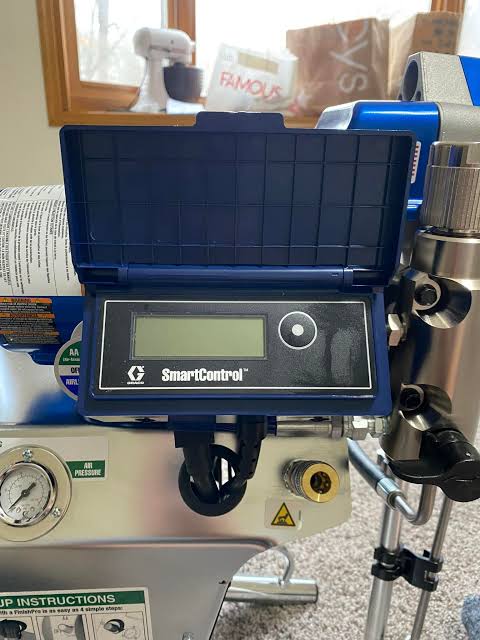
If you have been hunting for a FinishPro 395 parts manual and coming up frustrated, there is a reason, and it is not that the document is hard to find. It is that the name combines two separate Graco product families that work in fundamentally different ways.
Sorting that out is the whole job here. Once you know which machine you actually have, the manual question answers itself.
The Two Families Behind the Name
FinishPro is Graco’s fine finish line. These machines are built for cabinetry, millwork, trim, furniture and anything else where the surface quality matters more than the square footage. They come in HVLP versions and in air assisted airless versions, and both of those use air to help atomize the material. That is the defining characteristic: air is part of how the finish gets made.
395 is a model number from Graco’s conventional airless range. An Ultra 395 or a 395 PC is a straight airless sprayer. It atomizes by forcing material through a small orifice at high pressure. No air is involved in atomization at all.
So “FinishPro 395” describes a fine finish machine using a model number from the airless range. People arrive at that phrase honestly, usually because they own one of the two and have half remembered the name, or because they have seen both in the same shop.
The practical consequence is significant. Parts do not cross over between these families in any meaningful way, and the manuals describe different machines doing different things.
How to Tell Which One You Have
Three questions settle it quickly.
Is there an air hose going to the gun, or just a fluid hose? Two lines to the gun means air is involved, which puts you in the FinishPro family. One fluid hose means conventional airless.
Does the gun have an air cap, or a tip and guard? An air cap with holes around the fluid nozzle is fine finish equipment. A single orifice tip in a guard is airless.
Does the machine have a turbine, or a compressor connection? HVLP machines generate their own low pressure air with a turbine. Air assisted airless machines take compressed air from a separate supply. Conventional airless needs neither.
If you answer “air” to any of those, you want FinishPro documentation. The FinishPro II air assisted airless sprayers range covers the air assisted side, and the FinishPro HVLP sprayers range covers the turbine machines.
Why Air Assisted Airless Confuses People Most
Of the three technologies, air assisted airless is the one that causes the most trouble when searching for parts, because it genuinely is a hybrid.
It uses an airless pump to generate fluid pressure, the same as a conventional airless machine. Then it introduces a small amount of compressed air at the gun to refine the pattern and soften the edges of the fan.
So the pump side of an air assisted airless machine does resemble conventional airless equipment, and some fluid section logic carries over. The gun does not resemble an airless gun at all.
This is why somebody with an air assisted airless machine can search for airless parts, find things that look right for the pump, and then find nothing usable for the gun. The gun is the part that makes the machine what it is, and it belongs to a different parts universe.
What the Right Manual Actually Gives You
Worth being clear about why this matters, because “find the manual” sounds like a formality.
A parts manual gives you reference numbers against an exploded diagram. That is how you identify a component you can see but cannot name. Without it, you are describing a part over the phone and hoping.
More importantly for fine finish equipment, the operation manual gives you the setup figures: air pressures, fluid pressures, the relationship between the two, and the recommended starting points for different materials. On an airless machine you set a pressure and spray. On air assisted or HVLP equipment, the finish quality depends on the balance between air and fluid, and getting that balance wrong produces results that look like equipment faults.
A lot of fine finish complaints are setup problems. People arrive at a parts supplier convinced something is worn when the air pressure is simply too high for the material.
Finding Genuine Documentation
A few practical notes on this, since the search results for Graco manuals are full of sites that want your email address before showing you anything.
Graco publishes its manuals openly. They are PDFs on Graco’s own site, free, no registration. Any site asking you to sign up or pay for a Graco manual is repackaging something you can get directly.
The manual number is on the machine or on the original paperwork. It is a five or six digit number, sometimes with a letter suffix indicating the revision. If you have that number, you can find the document.
Manuals come in sets. For most machines there is an operation manual and a separate parts manual, sometimes a repair manual as well. The parts manual is the one with the exploded diagrams and reference numbers. People often download the operation manual, find no part numbers in it, and conclude the documentation is inadequate.
Check the cover for your model number. This is the step that gets skipped and causes the most downstream trouble. Graco manuals frequently cover several machines, and the cover lists which. If your model number is not on that list, the reference numbers inside do not describe your machine, even if it looks similar.
That last point deserves emphasis. A manual covering four machines will have callouts that differ between them, and working from the wrong one produces part numbers that are plausible and wrong.
The Fine Finish Consumables That Actually Wear
Whichever FinishPro variant you have, the wear items are different from airless equipment, and that is useful to know when stocking.
Air caps and fluid nozzles. These are the heart of the atomization on fine finish equipment and they wear. A worn air cap produces a pattern that will not stay even, which gets blamed on technique for a long time before anyone suspects the hardware.
Needle and seat. The fluid shutoff inside the gun. Wear here produces spitting on trigger release, which ruins finish work specifically.
Gun seals and o-rings. Exposed to solvent constantly on fine finish work, since the materials involved are usually more aggressive than architectural latex.
Filters. Fine finish work demands finer filtration than airless work, because the orifices involved are smaller and the surface quality standard is higher. A particle that would pass unnoticed on a wall is a defect on a cabinet door.
On HVLP turbine machines, the turbine filter. Neglected routinely, and a blocked one reduces air delivery, which changes the atomization.
Notice that most of this is at the gun. On airless equipment the pump is where the money goes. On fine finish equipment the gun is where the attention goes, and the pump is comparatively untroubled because the pressures are lower.
If You Actually Have a 395
Some people reading this will work through the questions above and conclude they have a conventional airless machine after all. In that case the documentation path is different and simpler.
The 395 shares a parts manual with several siblings in the same family, which means the cover check matters particularly. The pump on these machines is shared across a range of models, which is genuinely convenient for spares, and the manual will show you which callouts apply to your specific model number.
The fine finish question still comes up for 395 owners, though, in a different form. People buy an airless machine and then want cabinet grade results from it, which is asking the wrong technology to do a job it was not designed for. An airless machine can produce a decent finish with a small tip and careful technique, but it will not match air assisted or HVLP equipment on millwork.
That is worth knowing before buying parts in an attempt to improve a result that the machine cannot produce.
The Short Version
“FinishPro 395” is not a machine. It is two families overlapping in a search box.
If air is involved in atomization, you have FinishPro equipment and your consumables live at the gun: air caps, nozzles, needles, seals, fine filters.
If no air is involved, you have conventional airless equipment and your consumables live at the pump and the tip.
Either way, get the manual directly from Graco, note the manual number from the machine, make sure the cover lists your model, and reach for the parts manual rather than the operation manual when you need reference numbers.
And if you are not sure which family you are in, count the hoses going to the gun. One or two. That single observation resolves most of the confusion this name creates.