

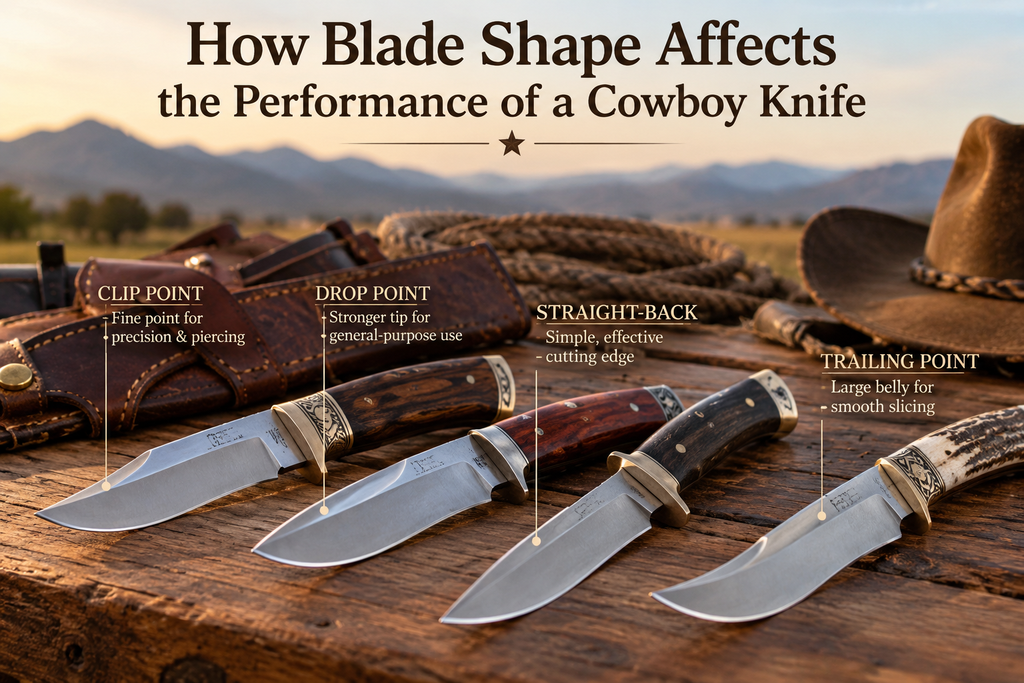
A cowboy knife is more than a Western-inspired accessory. Its blade shape influences how the knife handles, slices, pierces, and performs during everyday outdoor tasks. The profile of the blade determines the size of its belly, the shape of its tip, the amount of steel supporting the point, and how easily you can control the cutting edge.
For anyone choosing a traditional Western knife, understanding cowboy knife blade shapes can make it easier to match a knife with its intended use. Clip points, drop points, trailing points, and other profiles each have different characteristics. The right choice depends on the tasks you expect the knife to perform rather than appearance alone.
Why Blade Shape Matters in a Cowboy Knife
Blade shape affects the way a knife interacts with the material being cut.
A blade with a large curved belly can provide a smooth slicing path, while a narrow, acute tip can provide greater precision. A thicker tip can offer additional structural support, while a finer point can be useful for detailed cutting.
For cowboy and ranch style knives, skinning knife set for hunters ,these differences can matter when performing tasks such as:
- Cutting cord or leather
- Preparing food around camp
- General ranch chores
- Light carving
- Outdoor utility work
- Hunting-related tasks
- Controlled slicing
The blade profile does not work independently. Steel type, heat treatment, grind, edge geometry, handle design, and overall construction also affect performance.
Understanding the Classic Cowboy Knife Blade
Traditional cowboy knives often feature blade profiles associated with Western and Bowie-style designs.
The clip point is particularly recognizable. It has a section of the spine removed or “clipped” near the tip, creating a relatively fine point. The classic Bowie pattern is commonly associated with a sweeping belly and clipped point.
This combination gives the knife a distinctive Western appearance while also influencing how the blade performs.
The shape can provide:
- A defined point for precise work
- A useful curved belly for slicing
- A visually distinctive profile
- A balance between traditional styling and practical cutting
Clip Point Cowboy Knives
The clip point is one of the most recognizable profiles for a traditional cowboy or Bowie-style knife.
Its defining feature is the clipped section near the tip. The clip can be straight or curved, depending on the specific design.
Because the material near the tip is reduced, clip points can create a relatively acute point that is useful for detailed cutting and piercing. The tradeoff is that the tip generally has less material supporting it than a more robust drop point.
How a Clip Point Affects Cutting
The long cutting edge and curved belly can provide useful slicing performance.
The fine point can also make detailed tasks easier because you can concentrate cutting pressure into a small area.
However, the fine tip should not be treated as a pry bar. Lateral force or twisting can place significant stress on a narrow tip.
For that reason, a clip-point cowboy knife is better suited to controlled cutting and detail work than tasks that require excessive leverage.
Drop Point Cowboy Knives
The drop point has a different spine profile. Instead of being sharply clipped near the tip, the spine gradually curves downward toward the point.
This creates a relatively broad and well-supported tip while maintaining a substantial belly for slicing. Drop-point designs are widely used in outdoor and hunting knives because they combine control, slicing capability, and tip strength.
A cowboy knife with a drop-point profile can therefore provide a more general-purpose character.
Drop Point Performance
The larger belly can be useful for longer slicing movements.
The lower tip also provides a different cutting angle compared with a clip point. For users who want a Western-style knife with a more general-purpose blade profile, a drop point can be worth considering.
The choice ultimately comes down to the balance between tip characteristics, belly, control, and intended tasks.
Straight-Back Blade Profiles
A straight-back blade keeps the spine relatively straight from the handle toward the tip.
This creates a simple profile with a substantial cutting edge and predictable geometry.
Straight-back knives can be useful for general cutting and carving because the edge is easy to position against the material.
Although less visually distinctive than the classic clip point, this type of profile can suit users who prioritize straightforward cutting performance over traditional Bowie styling.
Trailing-Point Blades
A trailing-point blade has a spine and edge that sweep upward toward the tip.
This produces a large cutting belly that can be useful for slicing.
Trailing points are commonly associated with knives designed around slicing and skinning tasks. The long curved edge allows the user to maintain contact with material through a sweeping cutting motion.
For a cowboy knife intended primarily for general ranch tasks, however, the usefulness of this profile depends on the specific design and intended application.
How the Blade Belly Affects Performance
The blade belly is the curved portion of the cutting edge.
A larger belly generally provides more curved cutting surface. This can be useful for slicing because the edge can maintain contact through a controlled drawing motion.
A smaller belly produces a different cutting feel and may provide greater control for flatter cuts.
When comparing cowboy knives, do not look only at the overall blade length. Examine how much of that length is devoted to the belly, straight edge, and tip.
How the Tip Changes Cowboy Knife Performance
The blade tip is another important part of the profile.
A fine tip can be useful when precision matters. A broader tip generally has more supporting material behind it.
This creates a basic tradeoff:
Fine tip: greater precision and piercing capability.
Broad tip: greater structural support and general-purpose durability.
The clip point illustrates this tradeoff particularly well. Its distinctive clipped spine produces a defined point, but that point should be used appropriately rather than subjected to heavy lateral stress.
Blade Shape and Cowboy Knife Control
Control depends on more than blade profile, but shape contributes significantly.
A blade that feels natural during a cutting motion allows you to maintain better control over the edge.
The relationship between the tip, belly, handle, and guard also affects handling.
For example, a large belly may encourage sweeping cuts, while a more defined tip can make detailed work easier.
This is why two knives with identical blade lengths can still feel very different.
Blade Shape vs Blade Grind
It is important not to confuse blade shape with blade grind.
Blade shape describes the overall profile viewed from the side.
Blade grind describes how the blade’s thickness transitions toward the cutting edge.
For example, two cowboy knives can both have clip-point profiles while using different grinds.
Their cutting characteristics may therefore differ even though their silhouettes look similar.
When evaluating a knife, consider both the profile and the grind rather than relying on blade shape alone.
How Blade Shape Works With Handle Design
A good cowboy knife should have a blade and handle that complement each other.
The handle affects how securely you can control the blade, while the blade determines how that control translates into cutting performance.
A large clip-point blade paired with an uncomfortable handle may not feel as useful as its specifications suggest.
Look for a handle that provides:
- Comfortable hand positioning
- Secure grip
- Appropriate balance
- Smooth transitions
- Suitable guard or finger protection
- Durable construction
Natural materials such as wood, stag, bone, and horn can reinforce the traditional appearance of a Western knife, while modern materials can provide different combinations of traction and durability.
Choosing a Cowboy Knife for Ranch and Outdoor Tasks
When choosing a cowboy knife, start with the tasks you expect to perform.
For general outdoor cutting, consider a profile that offers a practical combination of belly, tip strength, and control.
For detailed work, a clip point can provide a more defined tip.
For broader general-purpose use, a drop point can offer a strong tip and substantial slicing belly.
For predominantly slicing-focused tasks, a trailing-point design may be worth considering.
There is no single blade profile that suits every situation. The important factor is matching the geometry with your intended use.
Traditional Western Style and Modern Knife Design
The popularity of cowboy knives comes partly from their connection to Western history and craftsmanship.
Modern makers can preserve recognizable Western characteristics while using contemporary blade steels, improved heat treatment, modern handle materials, and refined manufacturing techniques.
This allows buyers to choose between highly traditional designs and modern interpretations of the cowboy knife.
The result is a category where appearance and practical design can work together.
Choosing a Cowboy Knife From DivineKnives
For enthusiasts interested in traditional Western knife styling, DivineKnives offers a range of designs that can fit the visual character associated with cowboy and Western knives.
When evaluating a DivineKnives cowboy knife, consider more than its appearance. Look at the blade profile, handle material, overall dimensions, construction, and intended use.
A traditional cowboy belt knife can combine a recognizable Western aesthetic with the practicality of a fixed blade. The right design can become a useful addition to an outdoor gear collection while also providing the craftsmanship and character many knife enthusiasts value.
Cowboy Knife Blade Shape Comparison
| Blade Shape | Main Characteristic | Typical Strength | Important Consideration |
| Clip Point | Fine, defined tip with clipped spine | Precision and slicing | Tip requires appropriate use |
| Drop Point | Gradually descending spine | General-purpose balance | Less acute tip than clip point |
| Straight Back | Relatively straight spine | Predictable cutting | Less specialized tip |
| Trailing Point | Upward-sweeping profile | Slicing | Less suited to tasks requiring a reinforced point |
These are general characteristics. Actual performance depends on the knife’s dimensions, grind, steel, heat treatment, edge geometry, and construction.
How to Maintain a Cowboy Knife Blade
Regardless of blade shape, proper maintenance helps preserve performance.
Clean the blade after use and dry it thoroughly before storage. Carbon-steel blades may require appropriate protective oil to reduce corrosion, depending on the steel and manufacturer’s recommendations.
Avoid using the tip for prying or twisting. Even a robust blade can be damaged by misuse.
Sharpen the knife using a method appropriate for its edge geometry and maintain the original bevel as consistently as possible.
A leather or purpose-built sheath can also help protect the blade during storage and transport.
Common Mistakes When Choosing a Cowboy Knife
Choosing Only Based on Appearance
Western styling can be attractive, but appearance should not be the only consideration.
Look at the blade geometry, handle, balance, steel, construction, and intended use.
Assuming a Larger Blade Is Always Better
A longer blade does not automatically provide better performance.
The right size depends on the tasks you expect to perform and how comfortably you can control the knife.
Ignoring the Tip Design
The tip can dramatically change how a knife behaves.
A fine clip point and a broad drop point provide different combinations of precision and tip support.
Using the Wrong Blade for the Task
No blade profile is ideal for every job.
Match the blade’s characteristics to the work rather than forcing one knife to perform tasks it was not designed for.
Frequently Asked Questions
What blade shape is common on cowboy knives?
The clip point is strongly associated with traditional Bowie and Western-style knives. It combines a defined point with a curved cutting belly and has become an iconic part of the classic Bowie profile.
How does a clip point affect a cowboy knife?
A clip point creates a relatively fine tip that can be useful for detailed cutting and piercing. The blade also retains a curved belly for slicing. The narrower tip requires more care around lateral stress.
Is a drop point suitable for a cowboy knife?
Yes. A drop-point profile can provide a broad belly and a well-supported tip, making it a versatile option for outdoor and general-purpose cutting.
Does blade shape affect slicing?
Yes. The amount and curvature of the blade’s belly influence how the cutting edge contacts material. Profiles with larger bellies can be particularly useful for sweeping slicing movements.
Does blade shape affect durability?
It can. Tip geometry influences how much material supports the point. A broader tip generally provides more structural support than a very fine tip, although steel, heat treatment, grind, and thickness also affect durability.
What should I consider besides blade shape?
Consider blade steel, heat treatment, grind, edge geometry, handle material, ergonomics, balance, sheath, and overall construction.
Final Thoughts
The blade shape of a cowboy knife affects much more than its appearance. The clip point, drop point, straight-back, and trailing-point profiles each create different relationships between the blade’s tip, belly, edge, and spine.
A clip point can provide a distinctive Western appearance with a precise tip, while a drop point offers a broader, well-supported point and useful slicing belly. Other profiles provide their own combinations of control and cutting characteristics.
When selecting a cowboy knife, focus on the work you expect it to perform. Then consider blade shape alongside steel, grind, handle, balance, and construction.
For enthusiasts who appreciate Western-inspired craftsmanship, DivineKnives provides an opportunity to explore cowboy knife designs that combine traditional styling with modern knife-making considerations.